Archive for the ‘Uncategorized’ Category
Dolphin culture
My daughter sent me this link to a cool Reuters story. Apparently there is a cultural foraging fad underway involving tool use among members of an Australian Dolphin population.
What is the difference between LGT in prokaryotes and sex in eukaryotes?
Biologists are typically adamant that lateral or horizontal (used interchangeably) gene transfer in prokaryotes is not “sex” and should not be called that. Yet I keep running into people in print and in person, who, with little if any explanation, want to call it that. Are they just naive or could there be something more to it? So I decided to give the question some thought and here is what I came up with. Actually, it is quite difficult to pin down a principled difference between LGT in prokaryotes and sex in eukaryotes.
Consider a stereotypical case of LGT – conjugation in E-coli. Superficially it seems easy to characterize the difference. LGT is lateral (genes move between peers rather than being transmitted from parents to offspring), partial (only some of them do), and unidirectional (they move in one direction only).
Further consideration however suggests that things are not so simple. Eukaryotic recombination is, at least in part, just as “lateral” as is the prokaryote. Imagine an A1B1 haploid eukaryote engaging in sex and recombination with an A2B2. Whether the two loci are on different or on the same chromosome, together, they give rise to four offspring – two parental types an A1B1 and an A2B2 and two recombinant types an A1B2 and an A2B1. One way of looking at the recombinants is that a B2 has been transferred into an A1B1 displacing B1 while a B1 has been transferred into an A2B2 displacing B2 (or alternatively, an A2 has been transferred into a A1B1 displacing A2 and A1 has been transferred into a A2B2 displacing A2). Eukaryotic recombination then, is no less “lateral” than is the prokaryotic. This suggests we should stop talking about prokaryotic sexual processes as “lateral gene transfer” as if “lateral” were unique to them and talk about them simply as “gene transfer” (as some indeed already do).
Moreover, both prokaryotic and eukaryotic transfers are only partial. In eukaryotes, the non-recombinants A1B1 and A2B2 are, in effect, transmitted vertically rather than laterally, and with the recombinants, in the first version above A1 and A2 are as well, while only B1 and B2 are being transmitted through peers. This is not in principle unlike prokaryotes in which part only of the donor genome is transferred.
Is the bi-directional transfer in eukaryotes rather than uni-directional transfer in prokaryotes then the defining difference? With isogamy in eukaryotes, that seems to be the case. However, once anisogamy/oogamy has evolved from isogamy (as is thought to have been the case), genes are transferred there unidirectionally as well i.e. from the microgamete/sperm or its producer to the macrogamete/egg or its producer. Eukaryotic sex is associated with cellular reproduction (and involves syngamy, gene duplication and a pair of meiotic divisions) while prokaryote sexual processes are not and do not. In the eukaryotic case, cells “go”, at least initially, while in the prokaryotic case only genes do. So to some degree bidirectionality seems to be a fundamental difference with isogamy, but ultimately with anisogamy and oogamy in eukaryotes, that distinction too loses its force.
Another possibility is that prokaryotes are not organized into “good biological species” with sexual processes possible within species boundaries but not outside them as eukaryotes tend to be (occasional hybridizations notwithstanding). At first blush, it seems obvious that prokaryotes could not be. If F+ were driving through a closed population, sooner or later F- would go extinct and that would be that. However, negative frequency dependence could obtain between transmission of F+ through peers and F- through offspring with each being favoured when the other is rare as has been suggested. But that is not unlike the eukaryotic case in which Fisher’s ‘one mother, one father principle’ means that one mating type/gender is favoured when the other is common, and vice-versa.
Perhaps, related to uni and bi-directionality, the difference is based on the different natures of the social relationships among the parties involved. It has often been suggested that gene donors in prokaryotes are parasites, F+ and their like commonly being a plasmid, transposon or other mobile genetic element with a few host genes being dragged along with it (parasites of the parasite?). In some cases however, gene transfer seems to be in the interest of the recipient – antibiotic resistant factors can be transferred for example. However, gene transfer in prokaryotes may be in the interests of only one, or the other, but not both partners in various cases, while sex understood as genetic recombination in eukaryotes has historically universally been thought of as in the two parties mutual interest. Ultimately of course like bi-directionality, the cooperative theory of eukaryotic sex fails with the coming of anisogamy and oogamy if (and it is becoming a bigger if) the traditional explanation of gender differences and relations is accepted. There proto-males in anisogamy and males in oogamy are viewed as reproductive parasites of proto-females and females respectively.
If principled distinctions based on laterally, partiality, unidirectionality, good species and antagonistic versus cooperative social relationships all fail, at least ultimately, where does that leave us? In a muddle actually.
Research on cultural evolution keeps on coming
Research on cultural transmission and evolution just keeps on coming – so much so that I can hardly keep up! Great! For example, Andrew Whiten kindly drew my attention to a special issue of the Philosophical Transactions of the Royal Society B he co-edited with Robert Hinde, Kevin Laland and Christopher Stringer on the subject in April here. As well as an introduction by the co-editors titled “Culture evolves”, it includes 24 other reviews and research articles (many, despite their labels, are in substance a mixture of both.) The stated objective is to emphasize “important linkages between culture and evolutionary biology rather than quarantining one from the other”.
The first eight papers are about social learning in animals – its economics, in fish, birds, mammals particularly meerkats, capuchin monkeys, chimps, and two on the relationship between social learning and other aspects of intelligence.
These are followed by four papers on the evolution of stone tools, eight on diverse other aspects of cultural evolution in humans including archaeology, linguistics, politics and experimental social psychology for example and ending back where we began in a sense with four more papers focusing on social learning, but now in modern humans, particularly children.
This is a very rich resource which I recommend highly for professionals and students alike.
Fire and slings
Writing about the high density-favoured digestion (deriving more break down products from each unit of resources acquired) and re-production (deriving more grand-offspring from each offspring produced) in the last post reminded me of two popular science books written by academics that I read this spring. In effect, they have suggested the importance of these (in one case the former, and in another the latter) in human evolution.
In Catching Fire: How Cooking Made Us Human, Richard Wrangham proposed that fire, particularly for cooking (a form of pre-digestion), made possible the distinct human suite of adaptations and that foraging versus cooking was our primordial division of labour by gender. In Chpt. 3, “the energy theory of cooking” he well documents the evidence that cooked food yields more calories than raw, no matter the type of food, but he may not be quite right about why. He thinks it is because of a) “spontaneous” (i.e. purely phenotypic) benefits as demonstrated by the fact that even captive animals gain weight from cooked diets and b) evolutionary benefits owing to the reduced costs of a smaller gut once we began cooking (pp. 39-40). Because costs are difficult to measure, the more usual evolutionary ecological or socioecological logic is to hypothesize (and ideally demonstrate empirically) what logically would be most beneficial under different ecological or social conditions and to conclude from that what would be selected for, given equivalent costs. So what favours digesting more over eating more? Most obviously, high densities i.e. crowded conditions relative to resources do of course. If resources are plentiful, eat more; if they are scarce digest more i.e. derive more break down products from each unit of resources acquired – sometimes called efficiency over productivity. It is difficult to imagine that maintaining fire and cooking is actually cheaper than just picking up and eating raw food – it is unlikely to be cheaper, just more beneficial under conditions of food scarcity. It was apparently more beneficial enough to early humans to overcome the additional costs. The situation of relative (raw) food shortage was probably related to a cooling climate and the shift from forest to savannah-dwelling. These latter were presumably initially adapted to in an earlier phase by increased meat consumption as well as by the use of a variety of tools not only for acquiring food (digging sticks, weapons etc.), but also for processing by cracking, chopping, crushing etc. which Wrangham also discusses and shows also yield more calories per unit consumed.
Now from fire to slings (and yes, there is a connection!) In The Artificial Ape: How Technology Changed the Course of Human Evolution,Timothy Taylor’s over-arching theme is that culture in the form of technology shaping genes did not begin with farming and herding for example. Instead it has been with us from the beginning. Tools came first and by a special form of artificial selection, literally evolved us. “Having possession of fire, tools, weapons and clothes, we do not need massive teeth, claws and muscles, or a long vegetable-absorbing gut” (p. 28). For some (in my view not very good reasons), he does not think that culture literally evolves, but his general thesis that culture has shaped human anatomy, physiology, development and behaviour is so obviously brilliantly right in retrospect, that I won’t pursue that aspect of his book. He adds some anatomical details about facial shape, musculature and teeth to Wrangham’s theory but his more specific thesis is about slings for carrying babies which made us effectively artificial marsupials. Slings were what made possible the care of our extremely altricial young with their grossly disproportionate brain size in foraging societies of naked apes on the move. Not only do they free arms for gathering, but he provides evidence that carrying babies in slings is more energetically efficient than in arms. And of course I note that that form of parental care, like others, is an investment in offspring quality i.e. ultimately in re-production, the production of grand-offspring.
The conclusion I draw from these two books which nicely complement each other is that cultural evolution from the beginning, particularly fire and slings, shaped the human quality strategy of devoting more resources to digestion over consumption and to re-production over production.
Resource depletion and environmental degradation
I have suggested (e.g. in Darwinian Sociocultural Evolution Chpt. 4 and this blog, Evolutionary Myth 8 posted in August 2010) that resource depletion and environmental degradation do not necessarily go hand in hand as is commonly thought. Specifically, I argued that low densities relative to ecological resources favour consuming/producing more and are associated with small sizes and resource depletion, while high densities favour digesting/re-producing more and are associated with large sizes and environmental degradation. (The size association is because of the greater surface area/volume ratio useful in the former case and the greater volume/surface area ratio useful in the latter case). The associations however can vary depending upon how the four terms are further interpreted. Hanging out sometimes with philosophers who are experts at analysing concepts, including scientific ones, encourages one to pay attention to and dig out these kinds of distinctions.
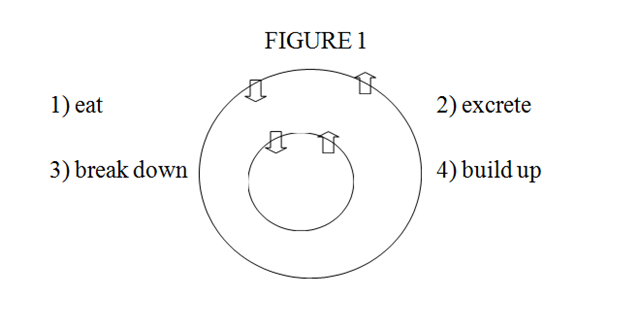
Consider only somatic functions as illustrated in the abstract in Figure 1. If consumption is understood as eating and excreting more (outer arrows 1 and 2) while digestion is understood as breaking down (degradative metabolism) and building up (biosynthetic metabolism) more (inner arrows 3 and 4), then sizes should be as stated – small versus large, but the former deplete and degrade the external environment while the latter deplete and degrade the internal environment. On the other hand, if consumption is understood as eating and breaking down more (left arrows 1 and 3) while digestion is understood as building up and excreting more (right arrows 4 and 2), then depletion and degradation should be as stated with the former depleting (the external and internal environments) and digestion degrading (the internal and external environments) but both sizes should be intermediate (although cost differences could shove both smaller or larger for example). An analogous break down can be applied to offspring production and re-production.
Such philosophical analysis of concepts can potentially be theoretically useful in the scientific sense. For example, the different interpretations described can be understood not just as different ways of analysing concepts, but as different ways in which genes specifying different components of life history strategies may be linked differently. For example, as originally suggested, the first breakdown could characterize heterospory or proto-genders with anisogamy while the second could characterize homospory or mating types with isogamy.
New evidence for world-wide cultural transmission and evolution of languages from Africa
Phil Regal kindly drew my attention to a post by Nicholas Wade and hence to Wade’s subject, a recent article by Quentin Atkinson in Science, “Phonemic diversity supports a serial founder effect model of language expansion from Africa” which is a real blockbuster.
Most historical linguists have long argued that historical relatedness among languages beyond families and a few super-families cannot be demonstrated with the kinds of linguistic evidence they prefer, and hence among other things they have been sceptical of the monogenesis theories and evidence of Merritt Ruhlen, Joseph Greenberg, Bernard Bichakjian and others. Atkinson has now exploded the former argument at least with a novel kind of linguistic evidence.
It has long been known that genetic and phenotypic diversity tends to be greatest in the homeland of a species and to decline towards its outermost ranges (e.g. in humans among Africans as opposed to elsewhere). That is because of serial founder effects. Increasingly distant local populations are founded by small, non-random samples of migrants from the less distant. Atkinson has now shown that the same thing obtains for phonemes of languages (the basic set of sounds including vowels, consonants and tones). In 504 languages around the world, Atkinson shows that a language has fewer phonemes the further one travels from Africa (actually specifically from central and southern Africa). Of course this effect of linguistic drift like that of genetic drift on diversity would decline if and when the more distant populations become large as well so Atkinson includes speaker population size in his models but the shadow of history remains impressively robust nevertheless.
The very first post I made to this blog in March of last year supported a common origin of human languages based not on linguistic, but on genetic evidence. I reasoned that if Homo sapiens sapiens share a single or perhaps two common historical origins in Africa 50,000 or so years ago as is currently thought (and nobody thinks language emerged later than that and many think much earlier), then the existence of a one or at most two “mother tongues” seems almost inescapable unless one wished to argue that one or more groups stopped talking for some generations and then began anew again which seems most unlikely. Atkinson does not argue specifically for a monogenesis theory of language. “This region (central and southern Africa) could represent either a single origin for modern languages or the main origin under a polygenesis scenario.” Nevertheless, his research provides strong evidence for the world-wide cultural transmission and evolution of human languages from Africa.
To evolutionists, his evidence is very powerful and the care with which the research was conducted is impressive including controls that biologists like to see such as those for the possibility of non-independence within language families. The quotes that Wade has obtained from traditional historical linguists on the article suggest that this may be the turning point for them to become more open on the subject. I will indulge in one minor complaint about how the ubiquitous developmental rather than an evolutionary analogy holds sway in the title of his comment - “Languages Grew From a Seed in Africa, Study Says”. NO NO NO! Languages (plural) did not “grow from a seed”, they evolved from an ancestor!
Anatol Rapoport, the game theorist of “tit-for-tat” fame among evolutionists, co-authored an article in the first issue of Behavioral Science in 1956 arguing for a detailed analogy between biological and cultural evolution, specifically with respect to language. Many years later he was on my Ph.D. thesis committee comparing theories of change in biology, psychology and the social sciences. The last time I saw him before he died was at a social gathering; he was quite deaf by then and the background noise was considerable. He took a firm hold of my arm and was very intense in telling me that he wanted me to know that phonemes are the (Mendelian) genes of languages. I know he would have loved Atkinson’s article.
Plastic protein molecules
The primary structure of a protein molecule is the sequence of amino acids in its chain and its secondary structure is the three-dimensional structure into which the former subsequently folds. On March 10, Nature (here) published a news feature titled “Breaking the protein rules” about the fact that many proteins, in part or in whole, do not assume a unique and fixed three-dimensional secondary structure. The terminology which seems to be emerging among physical chemists/structural biologists to describe the various phenomena involved include “intrinsically disordered”, “flexibility”, “multi-structural states” and “dynamic equilibrium”. Evolutionists too should be very much interested in these phenomena but would likely use different terms – e.g. roughly (secondary) phenotypic plasticity, adaptive plasticity, condition-dependent adaptive plasticity and development respectively.
That single protein molecules can possess such physiological/developmental/behavioural plastic properties (whatever one prefers to call them) normally associated with organisms is nothing less than astonishing. It has implications among other things it seems to me for understanding the origin and early evolution of life. In particular (leaving aside the question of membranes), it makes a protein-first rather than an RNA-first origin of life much more likely.
Early evolution by natural selection could have been based on something in between the very simple morphological (viability selection based on different static structures) and the very complex replicative (which includes heredity and an increase in numbers). In between is a simpler form of ‘repetition’ which could be called “competitive development” (see “The evolution of replication” here gated). The minimal conditions for such a type of evolution is a population of varying individuals, created by the direct action of the physio-chemical environment, in which two complementary alternative states each constructs the conditions that induce and favour the other. For example, polymers which were induced to grow when monomers were plentiful and to assume a more stable configuration when they were scarce would be favoured by selection over those which only grew, only maintained, or attempted to do both but under the reverse conditions because they would repeat their life cycle. Many other possibilities exist beyond growth versus maintenance e.g. growth versus motility with growth at one end and loss at the other resulting in the “tread-milling” form of motility utilized today by cytoskeltal elements for example.
Such a form of evolution could even result in increases in complexity because as many new “births” and deaths took place through time, the range of variation would increase. In any event, the increasing evidence for many “intrinsically disordered” i.e. plastic proteins deserve attention from evolutionists, including those interested in the origin and early evolution of life.
Two evolutionary pathways meet phylogenetics
In a previous post and elsewhere (e.g. here Biological Theory 2(1) 10-22 gated and here Spontaneous Generations ungated ) I suggested extending Van Valen’s definition of evolution to incorporate development and ecology and to acknowledge the fact that there are two distinct pathways to evolution by natural selection. New genes can reconstruct old environments or new environments can reinduce the expression of old genes or both, but even if both, one or the other is likely to lead and the other to follow initially. In an article this month (Trends in Ecology and Evolution V26#3 here), Schwander and Leimar call the first “genes as leaders” and the second “genes as followers”. P. Z. Myers once exquisitely analysed an experimental case on Pharyngula here (a case originally published by H. F. Nijhout in Science).
It is important that the possibility of “genes as followers” not be misunderstood as sneaking Lamarckian explanations for adaptation in by the back, or should I say by a side door! Environmental influences on phenotypes beyond the historically experienced range, just as novel genes expressing a norm of reaction beyond that historically expressed, are more likely to be maladaptive than adaptive – which is not to say that either cannot have a selective effect – albeit one usually negative, at least at first.
Now to the new development. Schwander and Leimar make the novel (but in retrospect obvious) proposal that which direction change has taken place in any particular case can be detected using phylogenetic methods. Recall that Darwin said that his theory of descent with modification was composed of two great principles – “the unity of types” (i.e. history) and the “conditions of existence” (i.e. natural selection). Since the work of Harvey and Pagel in the late 1980s and early 1990s, it has become common in evolutionary ecology, and even in some cases in anthropology, to control for the former in testing particular hypotheses about the latter. However such methods have never before to my knowledge been applied to this question.
Schwander and Leimar apply “ancestral state reconstruction methods” to the question of how commonly switches (and losses) have taken place between genetic polymorphisms and polyphenisms. They admit to many limitations of their study. They consider only discrete and not continuously varying characteristics. They use selected examples, i.e. the evidence is anecdotal. Nevertheless, by mapping genetic polymorphisms and polyphenisms (as well as losses) for the same phenotypic characteristics in the same larger group such as winged and winglessness in carabid beetle species and right and left handedness in Heteranthera plant species for example onto their phylogenies, they have begun to pave the way towards answering this fascinating question. Bravo!
From the series of examples considered, they conclude that there is “no clear tendency for genes to be followers or leaders overall”. However it is important to understand that an historical change to, does not necessarily mean a change by means of . An evolutionary change from a genetically polymorphic species to a polyphenic one could nevertheless have been initiated by a genetic mutation or recombination followed by selection for adaptive phenotypic plasticity under conditions of uncertainty but with reliable cues. However, given that virtually the identical alternative phenotype was present as a genetic alternative in the ancestral polymorphic species, it is more likely that the alternative phenotype was latent in the formation of the new species and came to be induced there at least initially by an altered environment. In other words, it was likely a change initiated by environmentally inductive means as well as a change to environmentally inductive control. Still, as the authors eventually make clear, “the frequency and direction of transitions between them depends not only on how often either system emerges but also on how often one system is more beneficial than the other. Polyphenism should be favoured when a phenotype-determining environmental cue accurately predicts the selective condition for which the corresponding morph is suited, whereas genetic polymorphism should be favoured when such environmental cues are lacking and there is local frequency dependence or spatial variation in conditions, combined with limited gene flow.”
Leigh Van Valen’s definition of evolution extended
Bill Wimsatt mentioned to me lately in an e-mail that Leigh Van Valen had died in the fall which I hadn’t known. By coincidence, in sorting through some old papers the next day with the aim of disposing of some of them, I came across a copy of Van Valen’s paper on “Three paradigms of evolution” from his journal (Evolutionary Theory 9:1-17, July 1989). I knew immediately why I had held onto this paper for so long – because it contained a mention of his previously published definition that “evolution is the control of development by ecology” which had struck me forcefully at the time and which I had always remembered.
Much later when Van Valen’s dissatisfaction with the definition of evolution as “change in gene frequencies in a population” had become much more widespread and in thinking about incorporating ecology and development in a definition (as well as taking into account standing or cryptic genetic variation, niche construction, and epigenetic inheritance), I came up with this extension of his definition:
“Microevolution by natural selection is any change in the inductive control of development (whether morphological, physiological or behavioural) by ecology and/or in the construction of the latter by the former which alters the relative frequencies of (genetic or other) hereditary elements in a population beyond those expected of randomly chosen variants.”
Before I published it in a couple of articles, Leigh was kind enough to tell me by e-mail that “I agree generally although not in detail.” I wish now I had quizzed him more and thereby perhaps have learned something else! The following is the rationale I eventually provided for the definition ( in Darwinian Sociocultural Evolution, 2010, 166-8 minus references).
“7.2 Two Pathways to Natural Selection – Preadaptations and Niche Construction
Natural selection is widely thought of as a sieve, filter or sorting device. For example, Dawkins writes “Each generation is a filter, a sieve: good genes tend to fall though the sieve into the next generation; bad genes tend to end up in bodies that die young or without reproducing” (1995:3). The origin of this metaphor is unknown to me but it is obviously intimately related to the genetical theory of evolution which defines evolution as “a change in gene frequencies in a population” (see any text in population genetics). It has been widely observed that this definition includes genetics and evolution but omits development and ecology. Once these latter are also brought into the picture, it is obvious that the “sieve” metaphor is so simplified that it is positively misleading (what follows in this section is adapted from Blute 2007, 2008a).
Natural selection never acts solely “backwards” as a sieve, filter or sorting device. Instead it always acts sooner or later inductively in a “forward” direction, altering the development of individuals. There are two fundamentally distinguishable pathways. First, an ecological change can induce some individual(s) of a pre-existing hereditary background to develop differently whether morphologically, physiologically or behaviorally relative to others. This is possible because phenotypes are plastic (Pigliucci 2001). This in turn can change relative fitnesses, and hence ultimately the frequencies of genetic or other hereditary elements in a population. If a new food source becomes available and is made good use of by some which are heritably different than others, the former are not just chosen; but changed. They may be induced by their altered nutritional status to grow bigger, live longer or produce more offspring for example. Similarly, a new antagonist like a parasite or predator does not bloodlessly choose; it too changes. In this pathway, the sequence is ‘eco-devo-evo-geno’. An ecological change induces a developmental change, which causes an evolutionary change (by changing the relative fitnesses of organisms – it is organisms not genes which survive and/or produce offspring), which causes a genetic change (a change in the frequencies of genetic or other hereditary elements in the population). This pathway (minus the ecological and developmental content) was traditionally called a “preadaptation” in evolutionary theory and thought to be relatively uncommon although more recently under rubrics such as “exaptation” and “co-optation” its probable commonness has been emphasized more.
The second pathway, instead of beginning with an ecological change against a pre-existing hereditary background, begins with a hereditary change such as a new genetic mutation or recombination against a pre-existing ecological background. A hereditary change leads some individual(s) to develop morphologically, physiologically or behaviourally in such a way relative to others that they perceive, define or construct a pre-existing feature of the ecological environment differently, changing it, thus changing themselves, thus changing relative fitnesses, and hence ultimately the frequencies of genetic or other hereditary elements. If a new hereditary element becomes available enabling its carriers to consume and make good use of a previously unutilized resource, the ecological environment is changed. That change in turn again does not simply sieve, filter, or sort but inductively alters the affected organism(s) improving their nutritional status, resulting ultimately in a change in gene frequencies. The sequence here then is ‘geno-eco-devo-evo-geno’ i.e. a genetic or other hereditary change is then followed by the same eco-devo-evo-geno change sequence as previously. This second pathway implies that niche construction, (Blute 1995, Odling-Smee et. al. 1996, 2003 but in substance see also Hansell 1984, 2000) is not a once-in-awhile phenomenon. Instead, it is the pathway through which all evolutionary change initiated genetically is achieved.
As a consequence of the need to incorporate ecology and development along with evolution and genetics and because of the existence of these two distinguishable “inductive” and “constructive” pathways, Blute (2007, 2008a) suggested the traditional definition of evolution by natural selection as a change in gene frequencies in a population be replaced by building on Van Valen’s (1973) observation that “evolution is the control of development by ecology”. This yields the following definition:
Microevolution by natural selection is any change in the inductive control of development (whether morphological, physiological or behavioural) by ecology and/or in the construction of the latter by the former which alters the relative frequencies of (genetic or other) hereditary elements in a population beyond those expected of randomly chosen variants.”
The evo-devo hour glass goes molecular but what explains it?
In the nineteenth century the great German embryologist Karl Ernst von Baer proposed laws of embryological development – that general characteristics and structural relations develop before special ones; the form of an embryo does not converge on that of others but diverges from them; and that the embryo of a animal never resembles the adult of another animal but only its embryo. In modern language, embryological development is a process of differentiation in the senses that parts of an embryo become differentiated from each other and that members of different but related groups become more different from each other. Although Von Baer was not an evolutionist, Darwin thought that the early similarity of members of different groups was the best evidence for his theory of common descent. As he wrote in the Origin, “Community of embryonic structure reveals community of descent.” (Von Baer and the reception of his laws are discussed by Scott Gilbert here.)
While evolutionary changes in development themselves are presumably attributable to selection and/or drift, this pattern of change in development – less change earlier, more later – is most readily explained by constraints. A genetic mutation or recombination which affected the earliest stage of development would have more side effects down the road than would one which first acted later, and many of these would likely be maladaptive. Analogous phenomena are found in other selection processes. For example, a rat learning a maze with a series of choice points reinforced at the end eliminates mistakes in a backwards direction i.e. change takes place more readily in the later than in the earlier stages of the entire sequence. The philosopher of biology, William C. Wimsatt, dubbed the constraint principle in the evolution of development “generative entrenchment”.
In the 1990’s however, it turned out that the empirical generalization ‘more evolutionary change has taken place later than earlier in development’ does not quite hold – rather the difference between members of different but related groups resembles an hourglass (discussed for example by Raff in The Shape of Life). Groups differ more in the very earliest phase of development, converge to become more similar (the hour glass narrows to what is called the phylotypic stage in animals), and then diverge again quite a bit for the bulk of the rest of development. Kalinka et. al. writing in Nature (gated) have recently confirmed this hourglass pattern for gene transcription involved in key developmental processes by comparing six species of Drosophila.
I argued (in Darwinian Sociocultural Evolution pp. 146-8) that the constraints logic implies that the in-between phylotypic stage of minimal change/differences between groups must represent the actual historical origin of the taxa involved. This interpretation has now been borne out by Domazet-Lošo et. al. writing in the same issue of Nature. Using “phylostratigraphic” methods they had previously pioneered, they found from the transcriptome (all RNA molecules present), that the genes expressed in Zebra fish in the equivalent of the animal phylotypic stage are indeed older than those from other, including the earliest phase. They also confirmed this for some other groups using data from the literature.
But another question remains, again if the constraints logic is valid, how has so much evolutionary change in the earliest phase of development been possible? I argued that it must be because what appears to be the earliest phase of development is in actuality a later phase. Such would be the case if it were largely a maternal effect i.e. a later phase of the mother’s development. Intriguingly Domazet-Lošo et. al. did find significant differences between the age of genes expressed in the late juvenile and adult phases of males and females in Zebra fish with more newer in females than in males. The authors suggest this may be related to recent sexual selection (although it should be noted that Zebra fish are not notably sexually dimorphic and there is little evidence that female choice is more significant than male-male competition among them – if anything, the reverse may be the case). However, the sex difference is not really a test of the maternal effect hypothesis anyway because on my understanding (and I am not a molecular biologist) while maternally inherited RNAs would show up in the transcriptome, what would not show up would be if they were maternally inherited, or transcribed from maternally imprinted genes, or expressed as a consequence of maternally inherited protein transcription factors for example.
In short, I eagerly await whether the maternal effects hypothesis of ‘too much’ change early in development can and will be tested. If confirmed, Von Baer’s law would in a sense be restored.

 Blute Blog