Archive for the ‘Uncategorized’ Category
You Tube Interview
Link to video interview given at and posted by the International Summer School on Evolution, University of Lisbon, Summer 2013.
Major transitions in evolution
Before going to Portugal to teach I attended the semi-annual meeting of the International Society for the history, philosophy and social studies of biology which was held this year in Montpellier, France. Along with Alejandro Rosas of the National University of Colombia, I organized and took part in a round table on the major transitions in evolution. Here are five questions I asked and what I had to say about them.
1) Should the topic be understood as “transitions” or additions i.e. as a change from one level of selection to another or as an addition of another level of selection?
I would argue for additions i.e. there is an evolving metapopulation of mitochondria in an evolving population of eukaryotic cells, an evolving metapopulation of cells in an evolving population of multicellular animals, an evolving metapopulation of modules in an evolving population of modular organisms and an evolving metapopulation of multicellular individuals in an evolving population of eusocial colonies etc. To employ a metaphor that has been used, such a point of view is neither deflationary nor inflationary but both simultaneously.
2) What is required for the emergence of an (additional) aggregate level of Darwinian individuals?
I agree with Godfrey-Smith that it is the emergence of entities subject to evolution by natural selection. However, rather than B, G and I (i.e. bottleneck, germ line and integration) I would argue that what is required is an additional aggregate developmental cycle, including but not restricted to a life cycle. That in turn requires a minimum of a complementary pair of life history strategies, each of which constructs the ecological conditions that favour, and in the transition or addition, come to induce (or whatever predicts them comes to induce) the other. So niche construction or eco-evolutionary dynamics are central. For example in a renewable environment, a cycle of plentiful resources which favour (and come to induce) growth, which constructs scarce resources, which favour (and come to induce) maintenance in the form of diapause for example, which constructs plentiful resources again – is a developmental cycle subject to selection, albeit not a life cycle, i.e. not progeneration in Griesemer’s sense.
3) Queller’s “fraternal” or what Nowak’s group has called the “staying together” case: is it attributable to kinship or ecology?
Staying together is better described as kin facilitated, because it most fundamentally requires an ecological explanation. If it’s hot and you need to lose heat it is better to be apart, but if it’s cold and you need to retain heat it is better to be together; if parasites are the greatest threat it is probably better to be apart, but if predators are the greatest threat it is probably better to be together; and so on. Such advantages of being small or large and there are many others, pertain to the advantages of having a proportionately greater ratio of surface area to volume for the small relative to the large or volume to surface area for the large relative to the small. The point is that kinship can facilitate either staying together or going apart depending upon ecological conditions. This implies that in the recent great debate between E. O. Wilson and (almost) everyone else in which he emphasizes the importance of ecology over kinship (defensible nests for eusociality for example), I have concluded that he is more right than wrong, including his 2012 description of genomes as chimeric (selected for at different levels) albeit not about some of the more fanciful extensions e.g. that humans are a eusocial species.
On the “staying together” case too, it is worth noting that a new life cycle it is not typically just a “staying together” but a cyclical staying together and going apart. For example cells in a multicellular organism reproducing asexually by multicellular propagules do not just “stay together” – they cyclically stay together and go apart – the propagules go apart from each other and if there are distinct reproductive and somatic cells, the reproductive ones go apart from the somatic.
4) Queller’s “egalitarian” or what Nowak’s group has called the “coming together” case: are sexual families additional Darwinian individuals and if so, what role do cooperation and conflict play in them?
Like Michod, I think sexual families likely are additional Darwinian individuals i.e. there is an evolving metapopulation of individuals in an evolving population of sexual families. However, sexual families too are not just a coming together but a cyclical coming together (fertilization) and going apart (meiosis) in haploids with a zygotic meiosis, or a going apart and coming together in diploids with a gametic meiosis. On the role of cooperation and conflict in these comings and goings, assuming an equal allocation to both at equilibrium, the simplest possibilities would be that in haploids for example, they either come together in conflict and go apart in cooperation, or come together in cooperation and go apart in conflict. The former (conflict then cooperation case) is implied by the traditional PBS theory of the evolution of anisogamy in which at fertilization, microgametes are viewed as reproductive parasites of macrogametes, but then recombination at meiosis is assumed, as it traditionally has been, to be mutually advantageous for whatever reason. The latter (cooperation then conflict case) is implied by the “market” or “trade” theory which Noë and Hammerstein originally suggested and I more recently have revived, and which might then be taken to imply that meiosis is a matter of conflict with genetic recombination a side effect of the mechanics of gene conversion rather than gene conversion a side effect of the mechanics of recombination. In a stunning recent paper, Laurence Hurst and some colleagues from China (Yang et. al. 2012) employed next generation sequencing techniques to determine that the great majority of recombination events in Arabidopsis (over 90% and probably nearer 99%) are gene conversion events. On the other hand, whether they come together in conflict or in cooperation, it is still possible that they go apart in cooperation – sexual families having discovered the advantages of risk reduction under uncertainty (like investing in index funds or dollar cost averaging rather than trying to pick stocks or time markets). What is unlikely I think is that both are a matter of conflict which would not pay back the two-fold cost of sex and would hence be unlikely to out compete asexuals.
5) Can it be said, as Bourke (2011) believes for example, that egalitarian or coming together transitions (or additions) require a “shared reproductive fate.”?
I doubt it. Assuming he means being confined inside the same ‘skin’ as say a vertically-transmitted symbiont, then I doubt it is necessary. I don’t know a lot about multispecies communities but occasional casual mutually positive interactions rather than regular cyclical ones between members of different species for example would not be sufficient. Nor do I think that “differential persistence” is sufficient – a slab of a hardwood persists longer than one of a softwood but are hardly Darwinian individuals (unless viewed as cultural ones). But I think it likely that theorists like Watson and Bouchard are still generally right. Some interspecific “coming togethers and going aparts” without remaining confined in the same ‘skin’ are likely systematic enough to indeed constitute additional Darwinian individuals. Positively non-additive fitness interactions at some stage at least sufficiently large enough to compensate for any negatively non-additive ones which may obtain at another would be a key requirement.
Photos from Lisbon
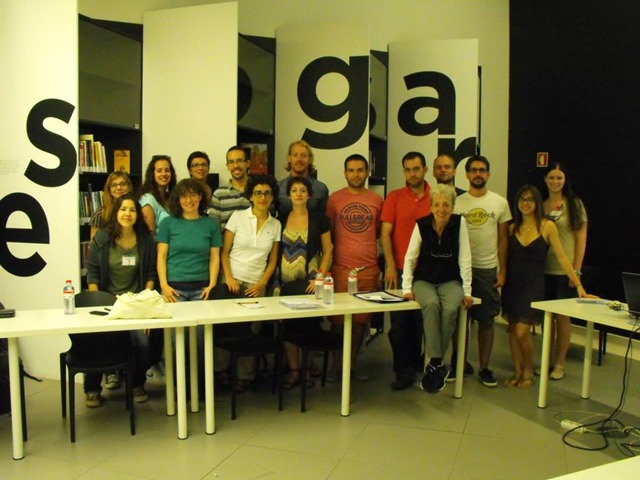
Instructors at the International Summer School on Evolution, at the Applied Evolutionary Epistemology Lab in the Faculty of Science, University of Lisbon. Left to to right, Derek Turner, Michael Ruse, Frédéric Bouchard, , Fiona Jordan, Nathalie Gontier, Marion Blute, Ilya Tëmkin, Luis Villarreal, Frietson Galis, Emanuele Serrelli.
Thanks to Nathalie and her staff for their hospitality and the pics!

My class.
The new cell biology
I have not been a very faithful blogger the last few months – whether that will change in the new year remains to be seen. I travelled more in November than usual and then spent December getting caught up on some book reviews, referees reports etc. that I had been asked for and had agreed to do. Among other things, I have been left with a pile of reading to catch up on. One thing that caught my attention as I began to do so was three related front-of-the-magazine pieces in Nature on December 1st, the first of which here was called “the new cell anatomy”.
Apparently a mixture of biophysicists, cell biologists and biochemists in recent years have been discovering all kinds of previously unknown structures inside of cells. The phenomena and terminology are bewilderingly diverse – various “tubes, sacs, clumps, strands and capsules” including filaments, nanotubes, purinosomes, microcompartments, carboxysomes, exosomes, cytoophidia (cell serpents) – some of which concepts undoubtedly will last, others of which undoubtedly will not. A lot of the discussion has been about the development of new methods as well as of applying old methods to single cells accompanied by a fair amount of arm waving about possible medical and industrial applications.
My point is that I hope in all of this, at least some of the researchers will keep their eye on a different question. As the late Lynn Margulis among others showed – there is a lot of knowledge to be gained about evolution working between the cell and the molecule, including by microscopy, newer fancier versions of which play a role in some of the new work. Since nobody thinks that life began de novo with prokaryotic cells fully formed, and since evolution always, always leaves marks of its history, there surely is a lot to be learned about the origin and early evolution of life by peering into, prodding and manipulating existing cells. So I very much look forward to eventually hearing more about the implications of the new work for that subject.
Why is my organic (kitchen) waste so heavy?
Like many cities in the developed world these days I suppose, mine has a recycling programme. Basically, organic (kitchen) waste is put out in one can once a week for composting; cans, bottles and paper in another every two weeks for recycling; garbage in a third every two weeks as well for disposal; and garden waste seasonally in paper bags. In our household, the first two are accumulated in similar sized plastic bags in containers in the kitchen and put out in the cans every once in a while, while the third is put out bagless in the third can more frequently as it accumulates. Now here is the puzzle. Whenever I happen to put out the first two at the same time, always in similarly sized bags and therefore similar in volume, the organics for composting are always, always heavier than the garbage for disposal, and by quite a lot. Every time I wonder why that is. Some possibilities might be:
– it’s just idiosyncratic to our household. I suppose if we were repairing cars and disposing of scrap metal (not that anybody would be, scrap metal is valuable these days) but if for the sake of argument we were, it would be different. But I doubt if our experience is unique (otherwise I would not be wondering about it here!)
– biological organisms need protection against antagonists, parasites and predators, hence the denser (from our point of view, waste) – thick skins, peels etc. as well as needing to reproduce – seeds etc. I doubt if that is the answer either. After all, a lot of our garbage is in fact protective – various kinds of non-recyclable packaging like the tissue thin plastic bags that bulk foods and produce are put in and some heavier packaging which have properties designed to persuade you to purchase it, i.e. to serve its reproduction.
-culturally-evolved processes have become more efficient than biologically-evolved ones. Now that is an intriguing possibility.
– finally my (originally an engineer) husband’s suggested answer is that the organic material is wet and water is heavy. Hmm – this possibility admits of an experimental answer, if we dried out a bag of organics would the weights be similar? I have never been much of an experimenter but . . .
Entanglements: Ecology & evolution, genes & culture, us & others
I was invited by Chris Kortright and Jaime Yard to take part in a session at the annual American Anthropological Association here meeting held last week in Montreal, a session which was titled “The Conceptual Work of ‘Ecology’”. The word that stuck out for me in the abstract provided for the session was “entanglements”. So I gave my talk the title above and here is the abstract of what I talked about.
“Not long ago it was thought that causal relationships between ecology and evolution were unidirectional – ecological environments (including physical environments and other species) structure evolving populations. We now know that the unidirectional view was false. Evolving populations also construct ecological environments (commonly called niche construction).
Similarly it was thought that causal relationships between genes and culture were unidirectional. The sociobiological/human behavioural ecological/evolutionary psychological revolution(s) revealed how the propensities of human nature, including our cultural nature, had been shaped by genetic evolution. But we now know that unidirectional view to have also been false. Anthropologists like William H. Durham played a significant role in showing how much our genetic evolution has been shaped by culture. A count (by Laland et. al. blogged about here on Dec. 8, 2010) includes 8 categories, some including as many as 30 genes, whose evolution can plausibly be linked to culturally-transmitted selection pressures. Thus came the era of not only gene-culture but also of culture-gene coevolution.
However, this theory and research remains anthropocentric. Genes and culture in the human species are viewed as coevolving in interaction with each other – i.e. excluding other species. However, the evidence that has been accumulating for decades now showing the ubiquity of culture and its evolution in other species implies that we are on the cusp of yet another revolution – interspecific gene-culture and culture-gene coevolution. And this revolution will not only be about our culture shaping their genes, but also about their genes shaping our culture.”
Some implications of the reinvention of grand theories of science
I enjoyed the annual 4S meeting (Society for Social Studies of Science) in Cleveland this week. I gave a talk with the above title which flowed from a paper titled “The Reinvention of Grand Theories of the Scientific/Scholarly Process” published with a graduate student, Paul Armstrong, in the current issue of Perspectives on Science (a paper which MIT press seems to have unusually made available for free here). That paper dealt with the work of ten contemporary sociologists and sociologically-minded philosophers of science who have presented general theories of the scientific/scholarly process on eleven issues. Methodologically it was done by means of an analysis of texts as well as interviews with the majority and was designed to assess the compatibility or lack thereof of their theories with each other and whether a new general theory is emerging. It ultimately concluded that it is a powerful argument in its favour that a Darwinian-style sociocultural evolutionary theory (of the general kind pioneered by Stephen Toulmin and David Hull) “can incorporate both all of the common and all of the useful unique features of contemporary grand theories of the scientific/scholarly process”.
The talk however was about four empirical generalizations not discussed in the paper that an evolutionary theory of science/scholarship can explain – the first from David Hull’s book Science as a Process, the second from my book, the third blogged about here on June 14, 2010, and the last from an article by Jonah Lehrer in The New Yorker on December 13, 2010 here.
i) Fraud and plagiarism. It is well known that the scientific community treats fraud (such as falsifying data) more harshly than it does plagiarism (although journal editors have begun to crack down more on the latter recently – perhaps because the availability of electronic data bases makes it easier to do so). According to Hull the reason for the traditional attitude is that plagiarism hurts only the ‘ancestor’ upstream i.e. the author or authors of the paper plagiarized while fraud hurts all those ‘descendants’ downstream – those whose time and energy spent building on falsified results has been wasted. You may have noticed that this has been one of the major complaints about the recent scandal involving Andrew Wakefield’s claims about the relationship between the MMR vaccine and autism and bowel disease. It resulted not only in damage to some of the children whose parents avoided having them vaccinated, but also in effort wasted on subsequently testing the theory – effort which could have gone into other better approaches to the causes of and treatments for these diseases.
ii) Citations to long papers. I was once puzzled to learn that longer papers gain more citations than shorter ones because the evolutionary ecology of life histories would predict the reverse. Without getting technical, the reason for that prediction is that under low density (plentiful resources) selection favours ‘productivity’ – eating a lot and producing a lot of (hence necessarily small) offspring. Under high density (scarce resources), it favours ‘efficiency’ – deriving more breakdown products from each unit of resources acquired and deriving more grand-offspring from each offspring produced (hence necessarily few, large offspring). In the light of this expectation that short papers would garner more citations but long ones would garner more citations to the papers that cite them, I was subsequently relieved to find out that studies have shown that many citations are not taken from original papers at all but from the citations of others to them. In short, many of the apparent “offspring” of long papers are likely not offspring at all, but grand-offspring. However, the necessary definitive study, comparing the “copied” citation rates of long and short papers has not to my knowledge been done.
iii) Mentors, students and their students. A study of roughly a century and a half of the lineages of mathematicians published in Nature last year showed a similar life history phenomena with respect to students rather than papers. The students of those who produce few students go on to produce about a third more students themselves than expected – i.e. less prolific teachers produce higher quality students who yield more grand-students.
iv) The truth wears off. The last example came to my attention from an article by Jonah Lehrer published in the New Yorker titled “The truth wears off.” It has long been known that there is a bias in science in favour of the publication of positive results. In the 1950’s for example, a statistician found that ninety-seven per cent of psychology papers found positive results. Perhaps authors themselves, and certainly referees and editors are loathe to publish results that say, “Nope I didn’t find what I was looking for, sorry”. What seems to happen is that if a novel, interesting result is found, a rash of confirmatory studies follow. What has not been so well known (and certainly not to me) is that such a trend is often followed by a trend in the opposite direction! What seems to happen is that by that time, the opposite result is the novel and interesting one and is therefore published, after which a rash of confirmatory studies of that follow. A cultural fad in science in one direction is followed by one in the opposite direction. Other observers of science have noticed more or less the same phenomena. Both continuity and innovation are valued in science but according to Hull, there is a tension between them. Citations claiming one’s work follows from that of others gains support but detracts from its apparent innovativeness, while originality is admired but detracts from the support that showing continuity provides.
The point I would like to make about this is that evolutionary theory has long been familiar with the phenomenon and has basically explained the reason for it. Evolutionists call it “negative frequency-dependent selection” – it being commonly adaptive to do the opposite of what the majority are doing because that reduces competition. So for example if most members of a population of birds are eating small seeds, an innovation (mutant) that eats large seeds could be favoured and spread until it becomes most common, upon which small seed eaters would again be favoured and so on. Actually, I suspect that avoiding competition may not be precisely the actual proximate explanation. The reason why large seed eaters are favoured when small seed eaters are common is because not only are the two kinds of seed eaters dependent on the exogenous availability of the two kinds of seeds, but because eating small seeds alters the ecological environment (depleting small seeds but permitting the population of large seeds to recover) thus favouring large seed eaters and of course vice-versa. Effects like these have recently come to be called “niche construction” i.e. the ecological environment not only structures populations but populations also construct their ecological environment. In science, both continuity and originality matter but not always simultaneously apparently.
Lehrer briefly discusses a number of other reasons for the truth “wearing off” – plain poor science, regression towards the mean in subsequent studies, data mining of studies with a large number of variables and comes to a more radical conclusion that I think justified – that “when the experiments are done, we still have to choose what to believe”. It is worth noting however that the sociological phenomena of negative frequency-dependent selection – cultural fads or social movements in one direction being followed by those in the opposite direction – does not readily explain the truth wearing off in a sequence of studies done by the same individual unless negative frequency-dependent selection works psychologically as well as socioculturally – at least one example of which Lehrer highlights. Maybe the story there is that we just get bored!
Thanks for the tips
Thanks for the tips to Tim Tyler – see his comment on cultural evolution keeps on coming in books as well as articles. I know Maria Kronfeldner and know she is not a fan, but hey, I am not into censorship. The list was ‘about’, not necessarily ‘for’.
In my view Ridley’s The Rational Optimist is only marginally about Darwinian-style sociocultural evolution in the scientific sense. It is an argument that human history is a story of progress brought about by the increasing scale of cooperation, specifically trade. Around the turn of the century, I used to give Robert Wright’s somewhat similar book Nonzero: The Logic of Human Destiny to students to read as a contrast to the pessimists such as Huntington’s Clash of Civilizations or Kaplan’s The Coming Anarchy.
I once wrote a long article which I never published on the application of sociocultural evolutionary theory to marketing. If and when I get back to the topic I will read Scaglia although if I understand the publisher, Project Webster, their books are “curated from Wikipedia” which does not inspire great confidence.
And finally, thanks for the tip to your book which looks like it is more up my alley and which I will definitely obtain and read.
Cultural evolution keeps on coming, in books as well as articles.
Not only articles, but also increasingly books on Darwinian-style cultural, social and economic evolution are being published. Great! In addition to ones previously mentioned here such as Runciman 2009, Blute 2010 and Hodgson & Knudsen 2010 – on my desk right now are:
Kate Distin. 2011. Cultural Evolution. Cambridge University Press.
Robert H. Frank. 2011. The Darwin Economy: Liberty, Competition, and the Common Good. Princeton University Press.
Maria Kronfeldner. 2011. Darwinian Creativity and Memetics. Acumen Publishing Ltd.
Alex Mesoudi. 2011. Cultural Evolution: How Darwinian Theory Can Explain Human Culture & Synthesize the Social Sciences. University of Chicago Press.
I haven’t read all four of these yet, but will be and am looking forward to it!
What is individual quality in evolutionary theory?
In an article “What is individual quality? An Evolutionary perspective” published in Trends in Ecology and Evolution 25(4) 207-204 in 2009 here, Wilson and Nussey reviewed the fact that the meaning of individual “quality” is commonly ambiguous in various biological literatures. Much of content of the article was an argument for better integration of (evolutionary) ecology with quantitative genetics. For better or worse, the vast majority of evolutionary (including behavioural) ecologists have opted for the “phenotypic gambit” as Alan Grafen famously called it. Presumably that is because they suspect that the genetic basis of the vast majority of the traits they are interested in, particularly behavioural ones, are not, and probably never will be known. That is an issue that cuts broadly across evolutionary ecology as does the issue of individual quality (e.g. as in offspring quantity versus quality), but the cuts intersect rather than coincide. Nevertheless, it is easy to agree with the article’s overall recommendation that “there is a need for authors to state more explicitly what they mean by individual quality in any given context”.
To reflect on this, consider some simple principles of evolutionary ecology blending foraging and life history theories – evolution under different densities, scales, in patchy, or uncertain environments (discussed slightly differently in Darwinian Sociocultural Evolution Chpt. 3).
1) Density (Figure 1): Assume spatio-temporal boundaries are fixed, but the amount of ecological resources varies. Ceteris paribus, low density relative to resources favours consuming/producing offspring individually while high density favours doing so by means of social interaction. As I noted in a recent review here, “after all, if most of the resources remain available in the ecological environment, it is towards it that one’s efforts should be directed; but if most have been absorbed into the population, then it is towards other population members that one’s efforts should be directed. The social interaction under high densities can be antagonistic (involving contact and aggression) or cooperative (based on economies of scale or specialization and exchange)” or a mixture of both. Given that sex is the most fundamental social relationship that exists among unrelated peers, it is not surprising that Graham Bell was able to show in 1982 in The Masterpiece of Nature that the strongest correlate of sex in animals is crowding. He showed that this is the case both intraspecifically (the easiest way to evoke sex in facultively sexual organisms is to crowd and starve them) and interspecifically (he characterized species-rich environments associated with sex like the tropics versus the poles, low versus high altitudes, and the ocean versus freshwater etc. as “biotically complex”).
FIGURE 1: DENSITY; BOUNDARIES FIXED, AMOUNT OF RESOURCES VARY
Low Density (Plentiful Resources) Versus High Density (Scarce Resources)
 |
 |
2) Scale (Figure 2): Assume the opposite i.e. the amount of resources are fixed but boundaries vary. Resources concentrated in time, space or niche favour fast, specialized consumption/production strategies; smeared out ones favour longer but slower, more generalized strategies.
FIGURE 2: SCALE; BOUNDARIES VARY, AMOUNT OF RESOURCES FIXED
Small Scale (Concentrated Resources) Versus Large Scale (Smeared Out Resources)


3) Patchiness: Assume both – boundaries and the amount of resources are fixed but resources may still be patchily distributed and individuals may be differently located with respect to them. Low local densities favour consumption/production, while high local densities favour 3M’s (maintenance/motility/mutability)/offspring 3M’s. For example, the most obvious way to devote resources to somatic maintenance is to digest more rather than eat more, thus deriving more breakdown products from each unit of resources consumed; and the most obvious way to devote resources to reproductive maintenance is to produce fewer, larger offspring, thus deriving more grand-offspring from each offspring produced. (On some of the complexities of the differences between 1) and 3) see footnote below.)
FIGURE 3: PATCHINESS; BOTH FIXED BUT PATCHILY DISTRIBUTED


4) Uncertainty: Simple uncertainty between any of these pairs of conditions favours bet hedging (doing both at random with some fixed probability); uncertainty with reliable cues favours adaptive phenotypic plasticity.
It seems natural to distinguish the alternative strategies in 3) informally as ones of “quantity” versus “quality”. (I have sometimes done so, usually resisting the temptation to put quality in scare quotes, but hopefully always in a context which makes the meaning explicit.). However, these three distinctions (maintenance, motility, mutability) are obviously not all substantively the same thing nor are they favoured under exactly the same conditions. What they do have in common is that they are all economic distinctions. They distinguish between spending on individual/demographic growth here/now versus investing in them for the future, whether in the current or in some other place/niche.
In the short run, selection acts in the short run but we also know that in the longer run it acts in the longer run. Given that the longer run is just the sum of a number of short runs, how is it possible for what is favoured in the two to be different? As long as it does not result in extinction, sacrificing quantity in the short run is possible if it is more than compensated for in some later short run. Hence quality in the short run is quantity in the longer run. What is favoured ultimately (assuming additive genetic variance) is what maximizes the net rate of individual/demographic growth across all temporal-spatial-niche regions occupied by the units subject to selection.
In some cases, quality may appear to be quantity right in the here and now, just less obviously so. Even if of the same size (volume/mass), different food prey/patches may differ in quantity even of energy content – an ounce of steak contains more calories than one of fruit and one of fruit more than one of foliage for example. Similarly among offspring – some of similar size might be constituted so as to be capable of producing more grand-offspring than others. Hence a fifth principle of evolutionary ecology seems needed: if the variance in relevant properties among resource items/offspring is low, it pays to consume/produce as much as possible; when it is high it pays to choose “quality”. On the other hand, this variance based principle may be viewed as just another way of talking about spending versus investing in a patchy environment. After all, how does one “choose” quality except by waiting (maintenance), moving (motility), or innovating (mutability)/provisioning offspring with these capabilities?
Going back to what selection maximizes, we know from complex life cycles and probably eusocial colonies that the units subject to selection can extend at least across more than one generation/conventional individual. However, how to identify these units in general remains a matter of much discussion and debate as anyone familiar with the modern literature on levels of selection, major transitions, etc., is aware.
A footnote on some complexities re the difference between 1) and 3):
One above is about absolute density while three is about local density under patchiness – but are they really different given that the upper left cells in 3) match the cells in 1) for example? Actually, the high density social strategies in 1) are liable to result in catastrophe – either because the population destroys itself through social conflict or because cooperation results in it hitting the carrying capacity of the environment under acceleration rather than deceleration, and subsequently crashing. However, if niche construction obtained i.e. if the ecological environment not only structured the population but the population also constructed the ecological environment, the outcome could be different. With niche construction included, low densities favour ecological strategies which construct high densities depleting ecological resources but giving social ones an opportunity to recover. Similarly, high densities favour social strategies which construct low densities depleting social resources but giving ecological ones an opportunity to recover. Were such a scenario to prevail, the likely outcome sooner or later would be negative frequency-dependence. Population members would evolve to anticipate ecological consequences and evolve instead to respond directly to frequencies in the population so that ecological strategies would be favoured if social ones were common and social ones favoured if ecological ones were common resulting in a stable equal allocation of effort in the population to the two alternatives.
In any event, by contrast, in 3) local density changes/differences are exogenous, imposed by ecological forces external to the interactions between the population and resource(s) at issue – for example, by seasonality. As a consequence, they can be responded to by the appropriate alternative – whether consuming/producing at low densities or 3M’s/offspring 3M’s at high. This still raises the question of whether, even given that at high local densities resources are expected to be plentiful elsewhere/in the future/in some other niche, could social strategies not evolve anyway? I think that is possible and the combination of the high density socially-oriented strategies from 1) and the ecologically-oriented ones from 3), whether simultaneous or sequential, may be what results in complex life cycles although that is another big topic which may be addressed in a future post.
(Revised, November 29, 2011.)

 Blute Blog